We may earn a small commission if you sign up for a service or product from this page. This does not affect our rankings and it does not cost you anything. Learn more about how we make money and our review process on our advertising disclosure page.

We funded a Titan account with $10,000 of our own money to find out whether the pitch matches the product. Short answer: it does, but the company you sign up with today is not the company most reviews are still describing. Titan has quietly turned into something else.
If you remember Titan as the “invest like a hedge fund” app for retail investors, that branding is gone. Today it is a registered investment advisor with human advisors, a flat 0.4% all-in fee, a $500 minimum, and a product menu that includes things hedge funds used to gatekeep (private credit from Apollo and Carlyle, an Apollo real estate fund, ARK’s venture fund). For a meaningful chunk of investors, that is a more interesting offer than the original ever was.
The rest of this review covers what we found running real dollars through the platform, where it earns its fee, where it doesn’t, and the 2023 SEC fine you should know about before you fund anything.
| Advisory Fee | 0.4% annually, flat (all-in, no transaction fees) |
| Minimum Investment | $500 |
| Assets Under Management | $1.1B (as of 12/31/2024) |
| Human Advisors | Yes, 1-on-1 (not rotating support) |
| Account Types | Taxable, Traditional IRA, Roth IRA, SEP-IRA, Trust |
| Strategies Available | Flagship, Opportunities, Offshore, Automated Stocks, Automated Bonds, Smart Treasury, Crypto, ARK Venture, Carlyle Credit, Apollo Credit, Apollo Real Estate |
| Mobile App | Yes (iOS and Android) |
| Fiduciary | Yes (registered as an RIA) |
| Notable | SEC settlement in 2023 ($1M) over hypothetical performance ads |
| Our Test Amount | $10,000 of our own money |
Our Test: $10,000 of Our Own Money
Every review on this site that says “we tested” means we tested. For Titan, we funded a live account with $10,000 in late 2022 and allocated across Flagship and Opportunities, plus a smaller exposure to the partner alternatives, across both an Individual taxable account and a Roth IRA. The point was not to game out returns over a sample size that small. The point was to see what a real Titan customer experiences in 2026, after the pivot.
What we tracked: account opening friction, time to first invested dollar, the actual feel of the dashboard, whether the human advisor was a real human, what 0.4% on $10K looks like in practice ($40/yr, paid in monthly slivers), how partner strategy fees stack on top of the advisory fee, and how quickly we could get our money back out when we asked.
Findings woven throughout the rest of this review. Where we have a specific number, it’s from our account.
What Titan Is Now
Titan launched in 2018 as a way for retail investors to get hedge-fund-style equity portfolios with a low minimum. Three concentrated equity strategies, no human advisor, content-heavy app, $25/month fees. That version of Titan is gone.
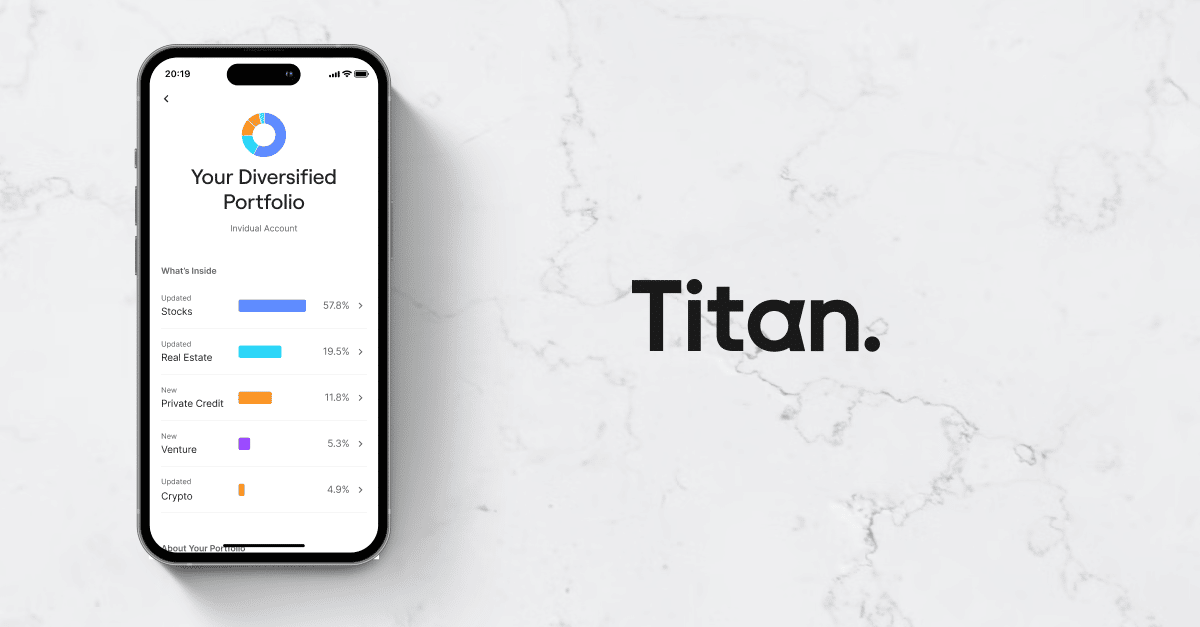
The current version is a registered investment advisor that pairs you with a real human advisor (we got a named advisor on day two, with calendar availability inside a week) and gives you access to a portfolio menu that has more in common with a private bank than with Wealthfront. Equity strategies are still there. So are automated stock and bond portfolios for the “I just want index funds” crowd. The interesting additions are at the top of the risk curve: alternatives that used to require accredited investor status or a private banking relationship to get near.
This matters for two reasons. First, the fee math is different now (0.4% flat, with a human advisor included, sits between standard robo pricing and traditional advisor pricing). Second, the audience is different. Titan is not pitching the Robinhood crowd anymore. They are pitching people who have equity comp, sudden liquidity events, an inherited account they don’t know what to do with, or “I have $200K sitting in a checking account and I’m 39 and I should probably do something.”
Fees: What 0.4% Flat Means
Titan now charges a flat 0.4% advisory fee on assets under management. That is the headline number, and on our $10K test account it works out to $40/year, billed in monthly slices of about $3.33. No transaction fees. No platform fees. No “premium” tier upsell.
For comparison at the same $10K balance: Wealthfront at 0.25% would cost you $25/year and Betterment at 0.25% the same, but at that price neither gets you a human advisor. Betterment Premium (advisor calls) requires $100K and runs 0.65%. Vanguard Personal Advisor is 0.30% with a $50K minimum. Titan at 0.4% is a touch more expensive than pure robo pricing and substantially cheaper than traditional human-advisor pricing (1%+ with much higher minimums). At small balances Titan is paying for the human; at larger balances the gap to a pure robo narrows in dollar terms but the human still costs about the same.
The catch worth understanding: the 0.4% is the Titan advisory fee. Some of the partner strategies carry their own fund-level fees on top. The ARK Venture Fund has historically run a 2.75% management fee with a total expense ratio north of 4%. Carlyle Tactical Private Credit has a 1.0% management fee plus a 15% performance fee over a 6% hurdle. Apollo Diversified Credit and Apollo Diversified Real Estate run their own fee schedules. These show up in the strategies’ net returns rather than as a separate line on your Titan invoice, which is normal industry practice but worth knowing before you allocate.
If you stay entirely inside Titan’s own strategies (Flagship, Opportunities, Offshore, Automated Stocks, Automated Bonds, Smart Treasury, Crypto), you pay 0.4% all-in and that is it.
In-House Equity Strategies
Flagship is Titan’s original U.S. large-cap concentrated equity portfolio. 15-25 holdings, picked by Titan’s investment team on a long-term thesis basis. This is the strategy that originally got people excited and the one Titan still pushes hardest in onboarding.
Opportunities is the small- and mid-cap equivalent. Same concentrated approach, riskier slice of the market, designed to sit alongside Flagship rather than replace it.
Offshore is international equities, same playbook. The pitch is that the team is finding mispriced compounders outside the U.S. that domestic-only investors miss.
Automated (Passive) Strategies
Titan added passive portfolios specifically to cover the “I want a boring three-fund portfolio managed for me” demand. Automated Stocks and Automated Bonds are diversified ETF-based portfolios that compete directly with Wealthfront and Betterment’s core offering. If you came to Titan for Flagship and stayed for the human advisor but want most of your money in index funds, this is where it goes.
Cash and Treasury
Smart Treasury is Titan’s high-yield cash account, parked in short-term U.S. Treasuries. Current yield runs in line with what you’d get at Wealthfront Cash or Betterment Cash, which is to say roughly in step with the front end of the Treasury curve. Useful if you’re holding cash you don’t want to invest yet and don’t want to leave at 0.01% in a brokerage sweep.
Crypto
Titan Crypto is an actively-managed crypto strategy tracking the Bitwise 10 large-cap crypto index with active overlay. 5-10 holdings. Honest read: if you want crypto exposure, a spot Bitcoin ETF in your brokerage account is cheaper and simpler. The case for doing it through Titan is mostly “I want my crypto allocation managed alongside my other strategies on one dashboard.”
Alternatives (Partner Funds)
This is the part of Titan that most other robo-advisor reviews skip, because most robo advisors don’t offer it. Through Titan you can allocate to:
- Carlyle Tactical Private Credit Fund: private corporate credit across cycles. 1.0% management + 15% performance fee over a 6% hurdle.
- Apollo Diversified Credit Fund: income-and-appreciation private credit.
- Apollo Diversified Real Estate Fund: blend of private real estate funds and public REIT exposure.
- ARK Venture Fund: Cathie Wood’s vehicle for private and public disruptive innovation. The fee load here is steep (2.75% management, ~4%+ all-in expense ratio). Useful for exposure, brutal as a cost basis.
These are interval funds with limited liquidity windows. You can’t pull your money out on a whim. The pitch is portfolio diversification into asset classes that don’t move in lockstep with the S&P 500. The risk is exactly that limited liquidity, plus the layered fees. If you allocate here, do it with money you genuinely don’t need for years.
What Our $10K Test Showed
Account Opening
From “click sign up” to “money invested” took about two business days. Identity verification was instant. ACH transfer cleared in two business days. Allocation across strategies happens after the funds land. No surprises, no document chases.
The human-advisor handoff happened on day two. We got a named advisor (not a chat queue), a calendar booking link, and a real intake call within the first week. The call was substantive (40 minutes, covered tax situation, time horizon, other holdings) rather than a sales pitch. Whether you use the advisor regularly is up to you, but they exist and they answer.
The Dashboard, Lived In
The mobile app is genuinely good. Performance views by strategy and aggregate, holding-level transparency in the active strategies (you can see exactly which 15-25 stocks Flagship is in this week), tax lot detail, and a tax-loss harvesting tracker that surfaces realized harvests rather than burying them.
The content layer (analyst videos, daily market notes, in-depth reports on holdings) is heavier than any other robo we’ve used. Whether that’s an asset or a distraction depends on you. We found ourselves checking the app more often than we needed to, which is the opposite of how a “set and forget” portfolio is supposed to work. If you’re prone to fiddling, this is not a feature.
Fees in Practice
0.4% on $10,000 = $40/year, billed at about $3.33/month. That number was visible in the app and reconciled exactly with the statements. No surprise line items. We allocated across Flagship, Opportunities, and a small partner-fund test position and the partner-fund fees were reflected in the NAV of those funds rather than on our Titan bill, which is the industry-standard way of doing it but means you should look at net returns for those strategies, not gross.
Withdrawal Test
We requested a partial withdrawal of $2,000 from the liquid strategies. From request to funds in our linked checking account: three business days. No friction. No retention pitch. The illiquid strategies (Carlyle, Apollo funds, ARK Venture) cannot be redeemed on demand. They have quarterly liquidity windows with caps. We did not have money in those for the test, but if you allocate there, build the lockup into your plan.
The 2023 SEC Fine
In August 2023, Titan agreed to pay $1 million to settle SEC charges that some of its prior advertising used hypothetical performance figures in a way the SEC considered misleading, plus a few related custody and compliance issues. Titan neither admitted nor denied the findings, paid the penalty, and updated its disclosures and ad practices.
Why it matters for you: nothing about the settlement implicates client funds or current operations. Custody is at Apex Clearing (the same custodian a lot of fintechs use), accounts are SIPC-insured up to $500,000, and the marketing practices that got them in trouble have been corrected. We mention it because you’ll find it if you Google around, and because a financial advisor’s regulatory history is something you should never just discover after you’ve funded an account.
Read the SEC release directly if you want the full text: it’s on sec.gov.
Who Titan Makes Sense For
The 2026 version of Titan is a reasonable fit if any of these describe you:
- You have $25,000 to $500,000 and you want a real advisor without paying a real advisor’s price.
- You hold company equity (RSUs, ISOs, NSOs) and you want help thinking through diversification, tax timing, or a sudden liquidity event.
- You want a small allocation to alternatives (private credit, private real estate, venture) without going through a private bank and without hitting accreditation walls.
- You inherited an account and you’d like someone to talk to before you do anything stupid with it.
Titan is a worse fit if any of these describe you:
- You just want a cheap three-fund portfolio that you ignore. Fidelity Go at 0% under $25K and 0.35% above is cheaper. Wealthfront and Betterment at 0.25% are cheaper. The human advisor is the thing you’re paying the extra for.
- You have under $5,000 to invest. The $500 minimum lets you in, but at that account size you’re paying $2/month in fees and the human advisor is not a meaningful upgrade over a free DIY brokerage account.
- You’re a fiddler. The depth of content and the per-holding visibility in Flagship will encourage you to second-guess decisions that you should leave alone.
Our Verdict After $10,000
Worth it for the right person. Titan has done the unusual thing of growing up while it grew. The pivot from “retail hedge fund app” to “actual RIA with humans” is more interesting than the marketing makes it sound, and the 0.4% flat fee with a $500 minimum is genuinely competitive for what you get. The alternatives sleeve (Apollo, Carlyle, ARK) is the part of the offer that nobody else at this price point has.
What we’d do differently if we started over with our $10,000: put more in Automated Stocks for the boring core, keep Flagship as a satellite rather than the core, and skip ARK Venture entirely at this balance (the fee load eats the case for it until you’re allocating real money to it). Smart Treasury for cash on the sidelines is a clear win.
We closed our Titan accounts (both the Individual taxable and the Roth IRA) in December 2024 after running them through the platform for roughly two years. The decision was about consolidating our test budget across other reviews on this site, not a verdict on Titan. The observations above are from our actively-funded period. If you want a more recent look, the product has evolved since (the platform restructured pricing again in late 2024) – check the “Last updated” date on this post for when we last re-ran the facts against the live site.