
We may earn a small commission if you sign up for a service or product from this page. This does not affect our rankings and it does not cost you anything. Learn more about how we make money and our review process on our advertising disclosure page.
On This Page:
As the millennial generation move into their best earning years, they’ll have the opportunity to financially secure their future with prudent investments. Although investment experts claim that diversity is the number one priority for a solid investment portfolio, one of the most overlooked investment options for value are quality stocks that carry a good dividend. There are plenty of good stocks that offer good dividends in the utility and industrial sectors. That’s always a good place to start.
Although many investors love dividend stocks for their regular passive income potential, the younger generation might want to focus on another time-tested strategy to instead help your portfolio grow exponentially. The strategy allows them to acquire more stock without putting any extra cash into your investment accounts.
This strategy is called dividend reinvestment.
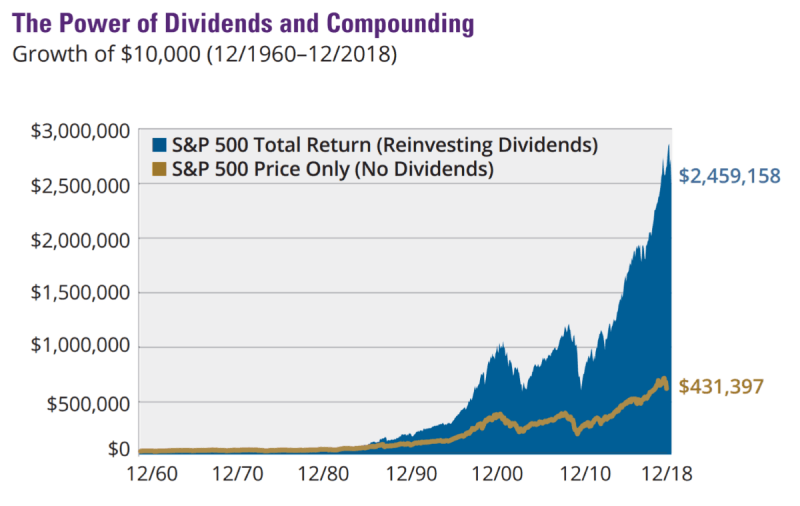 source: Hartford Funds
What is Dividend Reinvestment?
Dividend reinvestment is the investment strategy of taking dividends (scheduled payments from a corporation to its shareholders) and investing them back into the company for additional shares instead of receiving them as cash. Dividend Reinvestment Plans are often called DRIPs.
This is a crucial part of setting up an investment plan with a growth strategy vs. income strategy.
Companies that pay dividends on stock will pay investors their dividend per share at certain times during the year. Quarterly dividends are by far the most common option, though some companies choose to pay on an annual basis.
When a company declares and pays a dividend, investors have a choice. They can accept a wire for their dividends via a direct deposit into their bank account, or the company’s investor relations department will issue and mail a check to the investor. This is the “Cash” option for receiving dividends, which can be a great source of passive income.
But if you don’t particularly need that passive income right away and would rather watch your investment portfolio grow, you can also choose to reinvest the dividend back into the stock itself, which can mean compound growth over time.
How Dividend Reinvestment Works
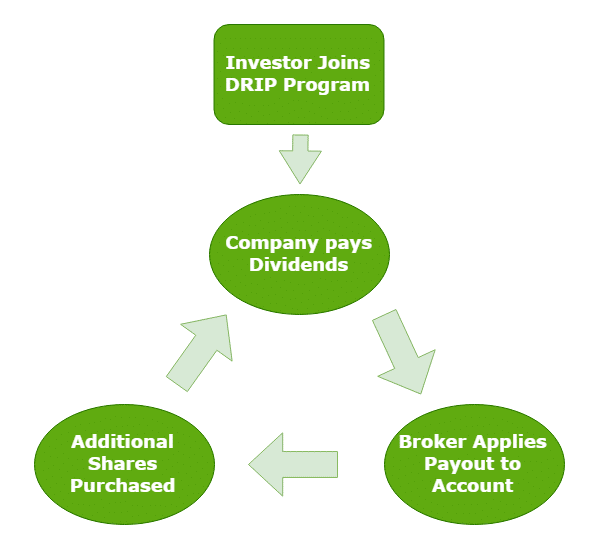
To start the process of dividend reinvestment, the stockholder needs to enter into the target company’s reinvestment plan. Many refer to this plan as a dividend reinvestment plan, or DRIP. Once the investor has enrolled, the company will convert future dividends into stock. The effective date of the stock purchase will be the date of dividend declaration. At that point, the company will hold the stock in the investor’s name.
By the way, the process will likely result in the investor ending up with fractional shares. That should be of no concern to the investor because they will still have the ability to transact business with the shares at any point in the future.
Although the term “DRIP” is usually referencing an employer-sponsored plan, it’s by no means exclusive to that. Many brokerages and robo advisors offer dividend reinvestment as a feature. We list some robo advisors that offer this feature near the bottom of this article.
Dividend Reinvesting vs. Taking Cash
As an investment strategy, reinvesting a dividend in stock makes a lot of sense. With cash in hand, the investor is likely to use the cash to cover personal expenses or purchase luxury items. That’s not a good way to develop one’s investment portfolio.
If the individual is looking for a more disciplined way to build their portfolio, the process of reinvesting dividends is the best option.
Wealthy Retirement has a Dividend Reinvestment Calculator where you can simply plug in your numbers and see the difference between reinvesting and withdrawing in cash.
TD Ameritrade has a great video explaining how dividend reinvestment plans work and their benefits:
Dividend Reinvesting: Pros and Cons
There is no one perfect investment strategy, otherwise everybody would be doing the same thing. Clearly, reinvesting dividends in stock comes with pros and cons of its own. It’s the pros that should be the driving force behind the choice to use the dividend investment strategy, and we strongly believe that the pros outweigh the cons, assuming growth is your goal.
Here are some of the pros of enrolling in a DRIP:
- The stock that is being granted via dividends requires no extra cash outlay
- The dividend stock has a maximum compounding feature
- The investor gets stock without having to pay commissions to a broker
- In many cases, the investor is able to purchase fractional shares without paying a premium
- Some companies offer a discount on stock the investor acquires with dividends. The discount could range between 1% and 10%
When investing, these kinds of benefits serve as great motivation to use this type of investment strategy. With that said, there are also some cons that come with this option. The most common cons include:
- The money goes to a very specific investment instead of going into another investment option (a bit less diversification)
- The stock purchased via dividends does not have the same liquidity as stock the investor purchases via cash.
- There’s is no tax advantage to converting dividends into cash
Dividend Reinvestments and Taxes
It’s important that investors fully understand the last con on the list above. To be clear, the dividends the investor uses to purchase more stock through a DRIP does not create a tax deferment. The value of the stock dividend is still dividend income the company and investor have to report to the IRS.
It’s the responsibility of the investor to include said income on their tax return to avoid tax issues.
Robo Advisors that Offer Dividend Reinvestment
 As the world of equity investment continues to evolve, the gap between the knowledge a person needs to be a prudent investor and the knowledge they have widens. The reality is today’s millennial generation has the financial resources to build a solid investment portfolio. What they lack is the knowledge or time to do it right. That’s where a Robo advisor and an automated investing plan can make a huge difference.
The process of using a Robo advisor is simple. Through a web-based program, the investor must register and answer a series of important questions. The Robo advisor will use the information the investor provides to build the right investment portfolio. The portfolio will likely reflect the investor’s risk tolerance and investment goals.
Once the requisite info is provided, the Robo will advise as to which investments the investor should include in their portfolio. FYI: Unless the investor clearly wants to use a high risk approach, most Robo plans will aim for diversity.
To be clear, reinvesting dividends is a strategy that many Robo advisors will take into account. They do so because of the commission free feature and the ability to buy stock at a discount. It’s a solid investment strategy. Any adviser would be remiss if they didn’t mention it to a client who wants to focus on building an income growth portfolio.
If you have an interest in automated investing, or don’t have the time or inclination to do the time-consuming research yourself, you might want to consider one of the following Robo advisors, all of whom include dividend reinvestment as a feature: M1 Finance, Wealthfront, Vanguard Personal Advisor Services, and Empower.